
A hard rain can leave any yard wet for a while. When the same areas stay soft, muddy, or covered in standing water for days, the property may have a drainage problem that rainfall alone does not explain.
Central Illinois properties can face several conditions that make these problems worse. Slow-draining soil, compaction, low spots, settlement, and poor grading can all affect where water goes after a storm. The right drainage solution depends on which of those conditions is actually causing the problem.
Why Some Central Illinois Yards Stay Wet Longer
Central Illinois gets hard rain events capable of exposing weak drainage quickly. Even in 2025, which tied as Peoria’s seventh-driest year on record, the National Weather Service recorded 29 days with heavy rain in Peoria, including seven days with at least one inch of precipitation.
Once rain reaches the ground, the property has to move or absorb that water. Problems start when the soil drains slowly, the grade sends runoff toward a low area, or there is no clear path for excess water to leave.
Local Soil Can Drain Slowly
Soil conditions are part of the problem on many properties in the area.
In a 2025 report covering Fulton, Mason, Peoria, and Tazewell counties, researchers at the University of Illinois noted that much of the region has soils that naturally drain excess rainwater slowly.
Saturated ground is also more vulnerable to compaction. As soil becomes denser, there is less pore space available for water to move through it. That can leave part of a yard soft long after surrounding areas have dried.
Low Areas Collect Runoff
A low spot does not need to look like a ditch to create trouble. A wide depression only a few inches lower than the surrounding ground can collect runoff from a much larger area.
Once that soil becomes saturated, additional rain has fewer places to go. The result can be recurring standing water or a section of yard that stays muddy for days.
Grading Can Change Over Time
A yard that drained well years ago can develop problems later. In a June 2026 article on flooding, researchers determined that erosion and soil settlement can create reverse grading around homes.
As the ground changes, water that once moved away from a home can begin moving toward it. That is why drainage work should start by looking at how the property handles water today.
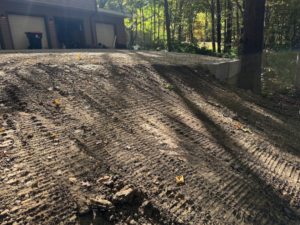
Regrading Can Correct How Water Moves Across the Yard
Regrading is one of the most direct drainage solutions when the shape of the ground is causing water to collect.
The goal is to establish elevations that move runoff away from buildings and low areas and toward a suitable outlet. This can involve reshaping a larger section of the yard rather than filling a single wet spot.
Regrading Low Areas
When water repeatedly pools in the same depression, correcting that low area may be part of the solution.
The surrounding grade matters just as much as the wet spot itself. Adding a load of dirt to the lowest point without considering where runoff will move afterward can shift the water into another part of the property.
Correcting Grade Around Structures
Settlement near foundations can reduce the slope that once carried water away from the house.
Regrading can restore that drainage path where site conditions allow. Elevations around patios, sheds, building pads, and other improvements may also need to be considered so water is not redirected into another low area.
Surface Drainage Gives Runoff a Clear Path
Some properties need a defined path that carries water across the surface.
Surface drainage uses the shape of the ground to collect or guide runoff toward an appropriate discharge area. Depending on the property, that can involve shaped drainage paths, swales, or other ways of controlling where stormwater travels.
When Water Crosses the Yard
You can often see surface drainage problems while it is raining.
Water may cut diagonally across the lawn, follow the edge of a building, or concentrate between two higher areas. Those visible flow paths show where runoff is already trying to go.
Correcting them can keep water from spreading across usable parts of the yard or settling where the ground is lowest.
When Runoff Washes Out Gravel
Repeated gravel loss can also point to a drainage problem.
Water crossing a gravel driveway or running hard along one edge can carry material away, create ruts, and wash out areas that were recently repaired. Adding more gravel may restore the surface temporarily while leaving the runoff pattern unchanged.
In those cases, the driveway grade and surrounding drainage need to work together.
Subsurface Drainage Can Help Where Water Stays in the Ground
Some wet areas have less visible surface runoff. Instead, the ground stays saturated because water is moving slowly through the soil or collecting below the surface.
Subsurface drainage is designed to collect that water and give it a controlled route away from the problem area.
When the Yard Stays Soft Without Large Puddles
A section of lawn can remain wet even when there is little visible standing water.
If the surface grade looks reasonable but the soil remains saturated, below-ground drainage may be worth evaluating. Soil conditions, elevation, the size of the wet area, and the available outlet all affect whether this type of drainage makes sense.
The Outlet Still Matters
A drainage system needs somewhere for collected water to go.
That outlet can be one of the most important parts of the entire project. Installing drainage without a suitable discharge point can leave the property with the same basic water problem in a different location.
Some Yards Need Grading and Drainage Together
Many wet-yard problems do not fit neatly into one category.
A low area may need to be reshaped while a drainage system handles water coming from another section of the property. A driveway may need its crown or slope corrected while runoff beside it is redirected. A settled area near a home may need grading along with another way to manage concentrated water.
This is where looking at the whole property becomes important.
Follow the Water From Start to Finish
The visible puddle is often the last part of the water’s path.
Runoff may begin uphill, move across a neighboring section of the yard, follow a driveway, and finally collect in one low area. Fixing only the final wet spot leaves the rest of that path unchanged.
A drainage assessment should identify where the water comes from, what controls its movement, and where it can safely go.
Match the Solution to the Site
The same drainage solution will not work on every property.
Slope, soil, buildings, driveways, neighboring runoff, existing drainage, and available outlets all affect the recommendation. That is why a property with standing water may need grading, surface drainage, subsurface drainage, or a combination of several approaches.
Signs You May Need Professional Drainage Work
A puddle after an unusually hard storm does not automatically mean the yard needs major work. Patterns matter more.
It is worth having the property evaluated when:
- Water stays for days. The same ground remains muddy or saturated long after the storm.
- The same areas flood. Water repeatedly collects in one part of the property.
- Runoff moves toward the house. Rain flows toward the foundation instead of away from it.
- The ground stays soft. Normal foot or vehicle traffic leaves ruts after rain.
- Gravel keeps washing out. Driveway repairs do not last because runoff continues crossing the surface.
- Past fixes have not lasted. Added dirt, topsoil, or gravel moved the problem without stopping it.
These symptoms give clues about the drainage problem. Elevation measurements and an onsite look at how water moves can show what is causing it.
Find the Right Drainage Solution for Your Property
Wissel Trucking handles drainage and yard grading work throughout Washington, Morton, Peoria, and surrounding Central Illinois communities.
We look at how water moves across the property, where it collects, and what site conditions are keeping the area wet. From there, the work can involve regrading, drainage improvements, excavation, or a combination based on the property.
If your yard stays wet for days after heavy rain, an onsite evaluation can identify the cause and determine which drainage solution makes sense before the next storm puts the property to the test again.